

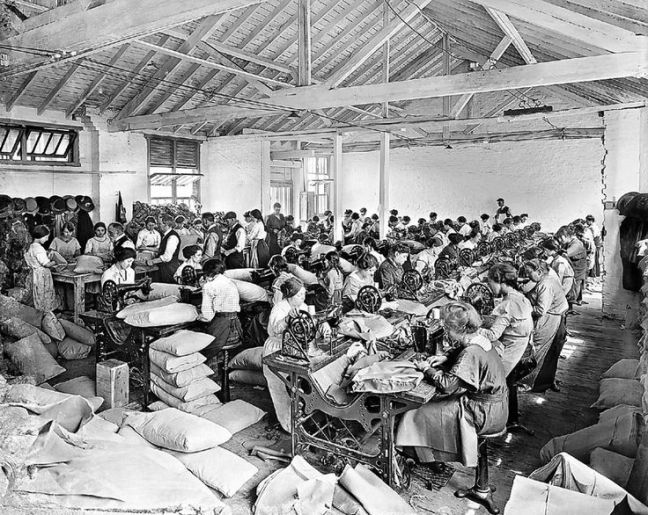
This installment of Making It, Ourselves feels very different from the last one (about my Bellows cardigan). The Bellows post came at the end of a 2-month-long process. Today’s is the result of just an afternoon of labor. Partly, that’s the difference between knitting and sewing. But also it’s the difference between a garment that I hope to wear for ages and a piece of quiet art that doesn’t need to fit any particular dimensions; it just needs to serve as a little reminder, a little tribute to the 19th-century seamstresses whose bodies were exploited and exhausted—and sometimes excited by the immoral rhythms of their sewing machines. (<– See last month’s History Project for more on that.) So, what I’ve made is not a perfect example of master sewing (not even close!), but it’ll hang on my wall and send out a reminding wave whenever I pass by.
When I thought about what might constitute a fitting homage to the excited seamstresses, I knew that it would have to be created using my sewing machine (obvs) and that its design would be based on rhythm and repetition. A wave motif seemed appropriate, as it satisfied the rhythmic-and-repetitive requirement and also could capture the back-and-forth surges of the act of sewing (especially as it would have been strenuously enacted on those first sewing machines). Additionally, I had the metaphorical meanings of a wave in mind—the experience of “waves” of pain or “waves” of pleasure. With these ideas in mind, I gathered my materials and set to work. Continue reading MAKING IT, OURSELVES: Waves of Work / Waves of Pleasure
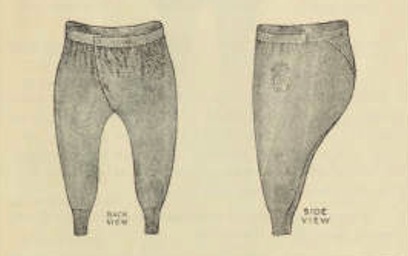
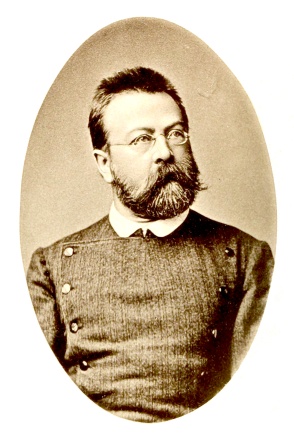 First, the Woolen System. Those of us who are spinners, weavers, knitters, and crocheters are well versed in the wonders of wool. But it was news to me that, more than a century ago, there arose an influential school of thought that wool is not only a practical material but also a supremely healthful one. In 1880, Dr. Gustav Jaeger (sometimes Jäger) published Standardized Apparel For Health Protection on the health benefits of wearing wool, and he followed it up with Health-Culture (<– how great/vague is that title?!) in 1887.
 The Fiber Archive